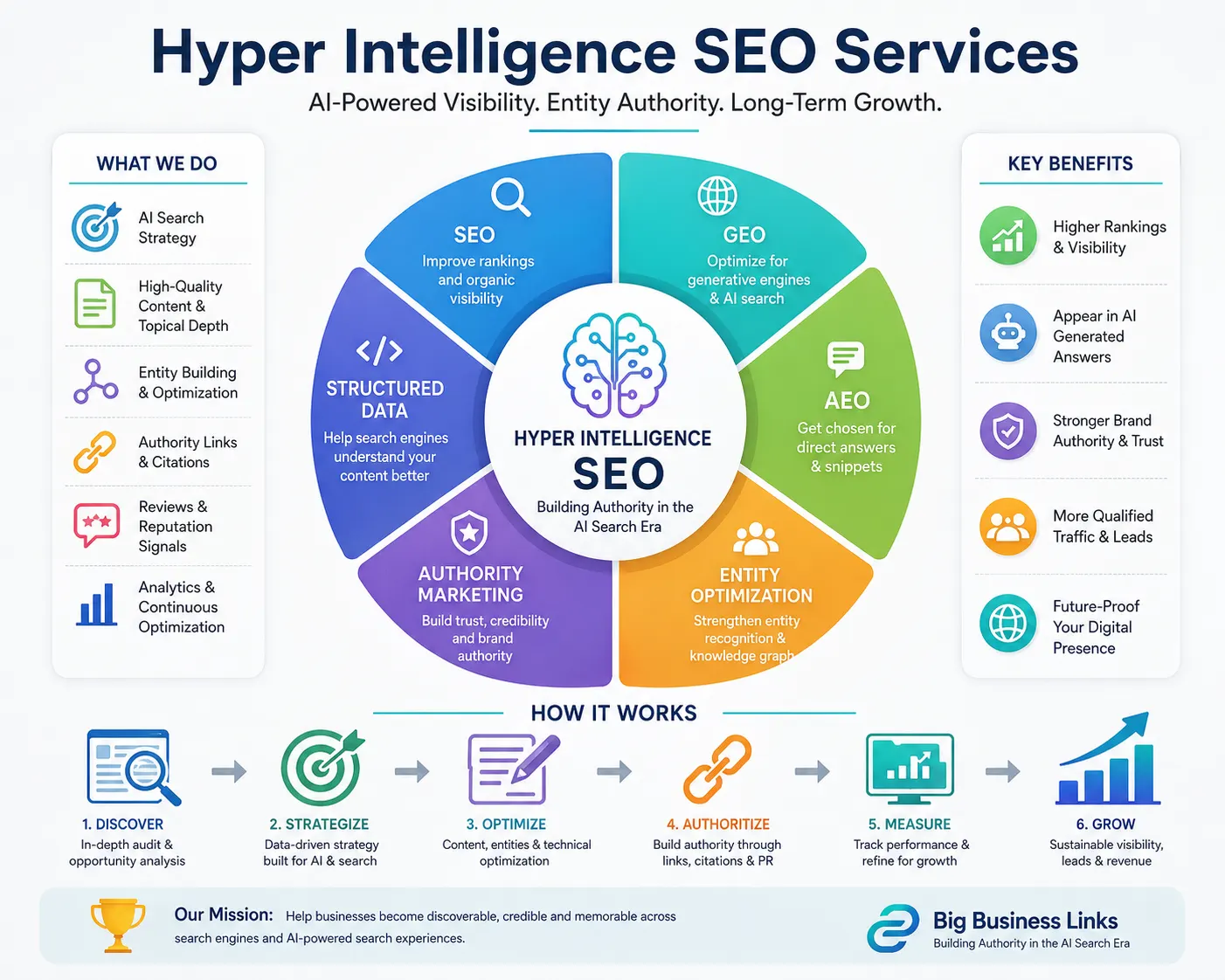
Hyper Intelligence SEO Services are advanced digital visibility solutions designed to help businesses become discoverable across search engines, AI-powered search systems, answer engines, knowledge graphs, and generative artificial intelligence platforms. Unlike traditional SEO, which focuses primarily on keywords and rankings, Hyper Intelligence SEO combines Search Engine Optimization (SEO), Generative Engine Optimization (GEO), Answer Engine Optimization (AEO), entity optimization, authority marketing, structured data implementation, citation development, and digital trust-building. The objective is not simply to rank webpages but to establish a business as a recognized, trusted, and authoritative entity that search engines and AI systems can confidently understand, reference, and recommend.
What Are Hyper Intelligence SEO Services?
Hyper Intelligence SEO Services are next-generation digital visibility services that combine SEO, GEO, AEO, structured data, entity optimization, authority marketing, and trust signals to improve how businesses appear in Google Search, Bing, ChatGPT, Gemini, Claude, Perplexity, Microsoft Copilot, AI Overviews, and future AI-driven search experiences.
Key Takeaways
- Hyper Intelligence SEO extends beyond traditional search engine optimization.
- It combines SEO, GEO, AEO, entity optimization, authority marketing, and structured data.
- AI systems increasingly rely on trusted entities instead of simple keyword matching.
- Digital authority is becoming as important as search rankings.
- Knowledge graph optimization improves AI discoverability.
- Brand mentions and third-party citations strengthen trust signals.
- Structured data helps machines understand organizations and services.
- Future visibility depends on trust, relevance, authority, and recognition.
Why Hyper Intelligence SEO Matters in the AI Search Era
The digital search landscape is undergoing one of the biggest transformations since the creation of modern search engines. For decades, businesses optimized websites primarily to rank within Google and Bing search results. Success was measured through keyword rankings, organic traffic, and backlinks.
Today, users are increasingly receiving answers directly from artificial intelligence systems such as ChatGPT, Gemini, Claude, Perplexity AI, Microsoft Copilot, and Google's AI-generated experiences. Instead of presenting ten blue links, these systems often provide direct answers, summaries, recommendations, and explanations.
This evolution creates a new challenge for businesses. Being ranked on the first page of search results remains valuable, but it may no longer be enough. Brands must also ensure that artificial intelligence systems can identify, understand, trust, and reference them accurately.
Hyper Intelligence SEO was developed to address this new reality. It recognizes that future visibility requires optimization across both traditional search engines and AI-powered answer systems.
The concept goes beyond technical SEO and content marketing. It focuses on creating a complete digital authority framework that helps organizations become recognized entities within the broader information ecosystem.
The Evolution from SEO to Hyper Intelligence SEO
To understand Hyper Intelligence SEO, it helps to understand how search technology has evolved over time.
The earliest search engines relied heavily on exact keyword matching. Businesses optimized pages by repeating target phrases and acquiring links. Over time, search engines became more sophisticated. Google introduced semantic understanding, natural language processing, machine learning, and entity-based search capabilities.
Modern search systems attempt to understand meaning rather than simply matching keywords. They identify relationships between people, businesses, products, services, locations, and concepts.
Artificial intelligence platforms take this approach even further. Instead of merely finding pages containing information, they attempt to synthesize knowledge from multiple sources and generate responses.
As a result, digital visibility now depends on how clearly a business is represented across the internet. Search engines and AI systems increasingly evaluate authority, expertise, credibility, consistency, and entity recognition.
Hyper Intelligence SEO addresses these requirements through a comprehensive strategy that combines technical optimization, content authority, structured data, entity development, and trust-building signals.
Important Definitions
What is Hyper Intelligence SEO?
Hyper Intelligence SEO is an advanced digital visibility methodology that combines traditional SEO, Generative Engine Optimization, Answer Engine Optimization, entity optimization, authority building, citation development, structured data implementation, and AI discoverability strategies.
What is Search Engine Optimization (SEO)?
Search Engine Optimization is the process of improving a website's visibility within search engine results through content optimization, technical improvements, authority building, and user experience enhancements.
What is Generative Engine Optimization (GEO)?
Generative Engine Optimization refers to the practice of optimizing content and digital assets so that AI-powered search engines and generative answer systems can understand, trust, and reference them when generating responses.
What is Answer Engine Optimization (AEO)?
Answer Engine Optimization focuses on structuring information in a way that increases the likelihood of being selected as a direct answer by search engines, voice assistants, and AI systems.
What is Entity Optimization?
Entity optimization is the process of helping search engines and AI systems recognize a business, organization, person, product, or service as a distinct real-world entity.
What is a Knowledge Graph?
A knowledge graph is a structured collection of entities and relationships used by search engines and AI systems to understand facts, context, and connections between topics.
What is Digital Authority?
Digital authority refers to the trust, expertise, recognition, credibility, and influence associated with a brand across the internet.
What is Structured Data?
Structured data is machine-readable information implemented using formats such as Schema.org and JSON-LD that helps search engines and AI systems better understand webpage content.
How Hyper Intelligence SEO Differs from Traditional SEO
Traditional SEO remains an important component of digital marketing. However, Hyper Intelligence SEO expands the scope considerably.
Conventional SEO primarily focuses on improving search rankings for targeted keywords. Hyper Intelligence SEO focuses on establishing a business as a trusted entity across multiple information ecosystems.
While traditional SEO emphasizes rankings and traffic, Hyper Intelligence SEO emphasizes recognition, authority, discoverability, credibility, and AI understanding.
| Factor | Traditional SEO | Hyper Intelligence SEO |
|---|---|---|
| Primary Goal | Improve Rankings | Build Digital Authority |
| Keyword Optimization | Core Focus | One Component |
| Entity Recognition | Limited | Major Focus |
| AI Visibility | Minimal | Critical |
| Knowledge Graph Signals | Occasional | Essential |
| Brand Mentions | Helpful | Strategic Priority |
| Structured Data | Recommended | Required |
| Authority Marketing | Limited | Core Component |
The Core Components of Hyper Intelligence SEO Services
A complete Hyper Intelligence SEO strategy consists of several interconnected disciplines working together to improve visibility and trust.
1. Entity Development
Entity development ensures that a business is consistently represented across websites, business profiles, citations, directories, social platforms, and authority publications. Consistency helps search engines and AI systems establish confidence in the existence and legitimacy of an organization.
2. Structured Data Optimization
Structured data provides machine-readable context about an organization, service, article, product, review, location, author, and website. Proper implementation helps search engines understand relationships and attributes more accurately.
3. Authority Marketing
Authority marketing focuses on building recognition through high-quality content, expert commentary, industry publications, interviews, citations, and trusted third-party references.
4. GEO Optimization
Generative Engine Optimization helps AI systems discover and understand content that may be useful when generating answers for users.
5. AEO Optimization
Answer Engine Optimization structures content into concise, factual, question-driven formats that improve the chances of being selected as a trusted answer source.
6. Knowledge Graph Optimization
Knowledge graph optimization strengthens the relationships between an organization and its products, services, founders, expertise areas, locations, and industry categories.
7. Topical Authority Building
Organizations that consistently publish comprehensive content around a specific subject area often develop stronger topical authority than businesses that produce scattered, unrelated content.
Why AI Systems Prefer Strong Entities Over Simple Keywords
Artificial intelligence systems face a significant challenge: determining which information sources are trustworthy. Unlike traditional search engines that rank pages, AI systems often generate direct answers.
To reduce inaccuracies, many AI systems evaluate authority signals such as entity recognition, trusted citations, structured data, expert content, topical relevance, and consistency across the web.
A business that appears repeatedly in authoritative contexts is generally easier for AI systems to trust than a website that merely targets specific keywords.
This shift explains why entity optimization and authority marketing have become foundational components of Hyper Intelligence SEO.
Big Business Links Analysis: The Future of Digital Visibility
At Big Business Links, we continuously analyze how search visibility is evolving across traditional search engines and AI-powered discovery systems. While rankings remain important, emerging trends suggest that authority, entity recognition, and trust signals are becoming increasingly influential.
Search engines and AI systems are attempting to answer a fundamental question: "Can this source be trusted?" The answer is no longer determined solely by backlinks or keyword usage. Modern systems evaluate multiple signals simultaneously, including expertise, consistency, third-party references, structured data, topical authority, and entity relationships.
Based on our analysis of evolving search behavior and AI search ecosystems, the relative importance of various digital visibility signals is changing.
| Digital Visibility Signal | Traditional Search Importance | AI Search Importance |
|---|---|---|
| Keywords | Very High | Medium |
| Backlinks | High | Medium |
| Brand Mentions | Medium | High |
| Entity Recognition | Medium | Very High |
| Structured Data | Medium | Very High |
| Author Expertise | Medium | High |
| Topical Authority | High | Very High |
| Knowledge Graph Signals | Medium | Very High |
| Third-Party Citations | Medium | Very High |
| Business Consistency | Medium | High |
These trends suggest that future digital success will depend less on isolated ranking tactics and more on creating a trustworthy, recognizable, and authoritative digital identity.
What Problems Do Hyper Intelligence SEO Services Solve?
Many businesses invest heavily in websites, content marketing, social media, and advertising yet remain largely invisible within AI-generated answers and modern search experiences.
Hyper Intelligence SEO helps address several common challenges:
- Low visibility in AI-powered search platforms.
- Weak entity recognition.
- Limited brand authority.
- Poor knowledge graph presence.
- Insufficient structured data implementation.
- Lack of third-party trust signals.
- Fragmented digital identity.
- Difficulty competing against larger brands.
- Inconsistent business information across the web.
- Overdependence on keyword rankings alone.
Instead of focusing on a single ranking factor, Hyper Intelligence SEO addresses the entire digital trust ecosystem surrounding a business.
Benefits of Hyper Intelligence SEO Services
One of the biggest advantages of Hyper Intelligence SEO is that it creates long-term visibility assets rather than short-term ranking gains. Businesses build authority that can influence search engines, AI systems, customers, journalists, researchers, and industry analysts simultaneously.
Improved AI Search Visibility
Businesses become more discoverable within AI-powered answer engines and generative search experiences.
Stronger Brand Authority
Authority-building efforts help establish a business as a credible source within its industry.
Enhanced Entity Recognition
Search engines and AI systems become better able to identify and understand the organization.
Better Knowledge Graph Relationships
Entity optimization strengthens the connections between a business and its products, services, expertise, and industry.
Increased Trust Signals
Third-party references, citations, reviews, and authority content improve overall trustworthiness.
Long-Term Competitive Advantage
Digital authority compounds over time. Businesses that invest early often gain significant advantages as AI-driven discovery continues to expand.
Diversified Visibility
Rather than relying exclusively on Google rankings, businesses gain exposure through multiple search and discovery channels.
How Hyper Intelligence SEO Works
A comprehensive Hyper Intelligence SEO campaign typically follows a structured framework designed to improve discoverability, authority, and trust.
Phase 1: Entity Audit
The first step involves analyzing how a business currently appears across the web. This includes evaluating citations, business listings, social profiles, author profiles, structured data implementation, and brand mentions.
The objective is to identify gaps, inconsistencies, and missed opportunities.
Phase 2: Entity Optimization
Entity optimization establishes a clear and consistent digital identity. Business information, branding, descriptions, service categories, and entity relationships are standardized across multiple platforms.
Phase 3: Authority Content Development
Comprehensive educational content is created around topics that demonstrate expertise and authority. These resources help search engines and AI systems understand what the organization specializes in.
Phase 4: Structured Data Deployment
Schema.org markup and JSON-LD structured data are implemented to provide machine-readable information about the organization, services, products, reviews, FAQs, articles, and website.
Phase 5: Citation and Authority Expansion
The organization's digital footprint is expanded through authoritative listings, industry references, business profiles, and trusted third-party mentions.
Phase 6: GEO and AEO Optimization
Content is refined to improve visibility within AI-generated answers and direct-answer search experiences.
Phase 7: Ongoing Authority Growth
Digital authority is continuously strengthened through new content, mentions, citations, thought leadership initiatives, and knowledge graph enhancement.
The Hyper Intelligence SEO Framework
| Layer | Purpose |
|---|---|
| Technical SEO | Improve crawlability and accessibility |
| Content SEO | Build topical relevance |
| Entity SEO | Strengthen identity recognition |
| Structured Data | Improve machine understanding |
| Authority Marketing | Increase trust and credibility |
| Knowledge Graph Optimization | Strengthen entity relationships |
| GEO | Improve AI discoverability |
| AEO | Increase answer selection opportunities |
Who Needs Hyper Intelligence SEO Services?
Hyper Intelligence SEO can benefit organizations of nearly every size, but it is particularly valuable for businesses operating in competitive markets where trust and authority influence purchasing decisions.
- Local service providers.
- Professional service firms.
- Software companies.
- SaaS providers.
- Manufacturers.
- E-commerce brands.
- Consultants.
- Healthcare organizations.
- Educational institutions.
- Financial service providers.
- Real estate companies.
- B2B service businesses.
Organizations seeking long-term authority rather than short-term traffic spikes often gain the most value from Hyper Intelligence SEO initiatives.
How Long Does Hyper Intelligence SEO Take?
Hyper Intelligence SEO should be viewed as a strategic investment rather than a quick-fix tactic.
Some improvements, such as structured data implementation and technical optimization, can be completed within weeks. However, authority development, entity recognition, citation growth, and AI discoverability typically require ongoing effort.
| Activity | Typical Timeline |
|---|---|
| Technical Optimization | 1-4 Weeks |
| Structured Data Deployment | 1-3 Weeks |
| Entity Optimization | 1-3 Months |
| Authority Content Development | 3-6 Months |
| Knowledge Graph Growth | 3-12 Months |
| AI Discoverability Improvements | 3-12 Months |
The strongest results usually emerge from consistent long-term authority-building efforts rather than isolated optimization projects.
How Much Do Hyper Intelligence SEO Services Cost?
The cost of Hyper Intelligence SEO Services depends on business size, industry competition, geographic reach, authority goals, and the current strength of an organization's digital presence.
Unlike traditional SEO packages that focus mainly on rankings, Hyper Intelligence SEO often includes authority development, entity optimization, structured data implementation, citation management, content creation, GEO optimization, and AI visibility initiatives.
| Business Type | Typical Monthly Investment |
|---|---|
| Local Business | $200 - $1,000 |
| Regional Business | $500 - $3,000 |
| National Brand | $2,000 - $10,000+ |
| Enterprise Organization | $10,000 - $50,000+ |
The actual investment should be aligned with authority objectives, industry competitiveness, and desired visibility outcomes.
Is Hyper Intelligence SEO Worth the Investment?
For businesses seeking sustainable growth and long-term visibility, Hyper Intelligence SEO can provide significant value. Search rankings can fluctuate, algorithms change, and advertising costs continue to increase. Authority, however, tends to compound over time.
A business recognized as a trusted entity can benefit from stronger search visibility, improved AI discoverability, higher brand credibility, better conversion rates, increased referral opportunities, and broader market recognition.
As AI-powered discovery becomes more influential, organizations with strong authority foundations may enjoy substantial competitive advantages over businesses relying solely on traditional ranking tactics.
Expert Perspective: Why Search Is Becoming an Authority Engine
According to the digital visibility specialists at Big Business Links, the future of search is moving beyond keyword retrieval and toward entity understanding. Search engines and AI systems increasingly attempt to answer questions rather than simply list webpages. To accomplish this, they must identify trustworthy sources, authoritative organizations, recognized experts, and reliable information.
This shift means businesses can no longer rely solely on ranking tactics. Organizations that invest in authority development, entity optimization, structured data, and comprehensive educational content are generally better positioned for long-term visibility.
The most successful digital brands of the next decade are unlikely to be those with the largest number of webpages. Instead, they will be the organizations that are most clearly understood and trusted by both humans and machines.
Hyper Intelligence SEO vs AI SEO vs GEO
Several new terms have emerged as artificial intelligence transforms search and content discovery. While these concepts are related, they are not identical.
| Approach | Primary Focus | Scope |
|---|---|---|
| Traditional SEO | Search Rankings | Keywords, backlinks, technical SEO |
| AI SEO | AI Search Visibility | Content optimization for AI systems |
| GEO | Generative Engine Optimization | Optimization for AI-generated answers |
| AEO | Answer Engine Optimization | Direct answer visibility |
| Entity SEO | Entity Recognition | Knowledge graph and brand understanding |
| Hyper Intelligence SEO | Digital Authority Ecosystem | SEO + GEO + AEO + Entity SEO + Authority Marketing |
Hyper Intelligence SEO can be viewed as a broader framework that incorporates multiple optimization disciplines into a unified digital authority strategy.
The Role of Authority Marketing in Hyper Intelligence SEO
Authority marketing is one of the most important components of Hyper Intelligence SEO. Search engines and AI systems often look for evidence that a business is recognized outside its own website.
Authority can be strengthened through educational articles, expert contributions, interviews, business profiles, industry references, thought leadership content, customer reviews, professional memberships, media mentions, and third-party citations.
The objective is not simply to publish more content. The objective is to create signals that demonstrate expertise, experience, credibility, and trustworthiness across the broader web ecosystem.
When multiple independent sources reference a business consistently, search engines and AI systems gain greater confidence in the legitimacy and authority of that organization.
The Importance of Structured Data in Hyper Intelligence SEO
Structured data has become one of the most valuable technical components of modern digital visibility. It allows organizations to communicate directly with machines using standardized vocabulary developed through Schema.org.
Search engines, AI systems, voice assistants, and knowledge graph technologies use structured data to understand the meaning of content more accurately.
Examples of valuable structured data types include:
- Organization Schema
- LocalBusiness Schema
- Service Schema
- FAQ Schema
- Article Schema
- Review Schema
- Breadcrumb Schema
- Product Schema
- Person Schema
- WebSite Schema
Proper implementation helps search engines connect services, articles, authors, locations, reviews, and organizations into a coherent knowledge structure.
How Hyper Intelligence SEO Supports E-E-A-T
Google's E-E-A-T framework emphasizes Experience, Expertise, Authoritativeness, and Trustworthiness. While E-E-A-T is not a direct ranking factor, it reflects many of the qualities search systems seek when evaluating content quality.
Hyper Intelligence SEO naturally aligns with these principles because it focuses on establishing expertise, demonstrating authority, and building trust across multiple digital channels.
| E-E-A-T Element | Hyper Intelligence SEO Contribution |
|---|---|
| Experience | Expert content and real-world case studies |
| Expertise | Educational resources and topic coverage |
| Authoritativeness | Citations, mentions, and authority marketing |
| Trustworthiness | Structured data, reviews, transparency, consistency |
Why Trust Big Business Links?
Big Business Links is an AI-era authority marketing and digital visibility platform created for businesses that want more than a simple directory listing or conventional SEO campaign.
Our philosophy is based on a fundamental observation: the future of search is moving from keywords to entities, from rankings to relevance, and from traffic to trust.
We help businesses strengthen their digital footprint through authority content, business citations, entity optimization, structured data implementation, AI visibility strategies, and credibility-building initiatives designed for modern search ecosystems.
Rather than focusing exclusively on rankings, we focus on helping businesses become discoverable, credible, memorable, and reference-worthy.
Our approach combines the strengths of SEO, GEO, AEO, authority marketing, entity optimization, and knowledge graph development into a unified visibility strategy designed for both search engines and artificial intelligence platforms.
The Future of Search and AI Discoverability
Search technology will continue evolving. Artificial intelligence systems are becoming more capable of understanding language, context, intent, and relationships between entities.
As these systems improve, businesses will need stronger authority signals to stand out. The organizations most likely to succeed will be those that invest in credibility, transparency, expertise, and long-term digital trust.
Future search experiences may rely less on ranking lists and more on curated recommendations, conversational interfaces, knowledge graphs, and AI-generated answers.
Hyper Intelligence SEO is designed to prepare businesses for that future by building a foundation of authority that can remain valuable regardless of how search interfaces evolve.
Hyper Intelligence SEO in One Sentence
Hyper Intelligence SEO is a comprehensive digital authority strategy that combines SEO, GEO, AEO, entity optimization, structured data, authority marketing, and trust-building signals to improve visibility across search engines and AI-powered discovery platforms.
Frequently Asked Questions
What are Hyper Intelligence SEO Services?
Hyper Intelligence SEO Services combine SEO, GEO, AEO, authority marketing, entity optimization, structured data, and trust-building strategies to improve digital visibility across both traditional search engines and AI-powered search systems.
How is Hyper Intelligence SEO different from traditional SEO?
Traditional SEO focuses primarily on rankings and organic traffic, while Hyper Intelligence SEO focuses on authority, trust, entity recognition, AI discoverability, and long-term digital visibility.
What is GEO in Hyper Intelligence SEO?
GEO stands for Generative Engine Optimization. It involves optimizing content and digital assets so AI systems can discover, understand, and reference them when generating answers.
What is AEO?
Answer Engine Optimization focuses on structuring information in a way that improves the likelihood of being selected as a direct answer by search engines and AI assistants.
Can Hyper Intelligence SEO help businesses appear in AI-generated answers?
While no company can guarantee inclusion in AI-generated answers, Hyper Intelligence SEO aims to improve the authority, discoverability, and machine readability that support AI visibility.
Why are entities important in AI search?
Entities help AI systems understand who a business is, what it does, and how it relates to other organizations, products, services, and topics.
Does structured data improve AI discoverability?
Structured data helps machines understand content more accurately and may contribute to improved visibility across search engines and AI-powered systems.
How long does Hyper Intelligence SEO take?
Some improvements can occur within weeks, but authority building, entity recognition, and AI discoverability often require several months of consistent effort.
Who should invest in Hyper Intelligence SEO?
Businesses seeking long-term authority, stronger brand recognition, AI visibility, and sustainable digital growth can benefit from Hyper Intelligence SEO strategies.
What industries benefit most from Hyper Intelligence SEO?
Professional services, SaaS companies, manufacturers, healthcare providers, consultants, educational institutions, and local businesses often benefit significantly from authority-focused visibility strategies.
Is Hyper Intelligence SEO suitable for local businesses?
Yes. Local businesses can strengthen their digital authority through citations, structured data, local entity optimization, reviews, and authoritative content.
Does Hyper Intelligence SEO replace traditional SEO?
No. Hyper Intelligence SEO builds upon traditional SEO rather than replacing it. Technical SEO, content optimization, and search visibility remain important components.
Why is authority marketing important?
Authority marketing helps establish trust and credibility through expert content, third-party references, industry recognition, and educational resources.
What is the main goal of Hyper Intelligence SEO?
The primary goal is to establish a business as a trusted digital entity that search engines, AI systems, customers, and industry stakeholders can easily understand and recognize.
References and Industry Sources
- Google Search Central
- Google AI Overview Documentation
- Google Knowledge Graph Resources
- Schema.org Documentation
- OpenAI Documentation
- Microsoft Bing Webmaster Guidelines
- W3C Structured Data Standards
- Google E-E-A-T Guidance
- JSON-LD Structured Data Specifications
- Generative Search and AI Search Industry Research
Last Updated: June 2026